Lever 02 · Outlook
How do agents build scenarios by the book?
An Outlook agent takes the selected drivers step by step through the classic scenario process: interconnection, assessment by impact and uncertainty, key factors, scenario framework, write-up. At each junction a human confirms before the agent moves on.
01 / Process
From driver to scenario in seven steps
- Take over the drivers
The starting point is the set of drivers a human selected from Scout's proposals, each with its evidence.
- Impact matrix
Every driver is rated against every other: how strongly does A affect B? Row and column totals give the active and passive sums, which show which drivers push the system and which are pushed by it. The approach goes back to Frederic Vester's paper computer.
- Wilson matrix
Drivers are placed by impact and uncertainty. High impact with low uncertainty belongs in every scenario; high impact with high uncertainty is what sets the scenarios apart.
- Select key factors
Both matrices together point to a small number of key factors with high impact and an open outcome.
- Set up the scenario framework
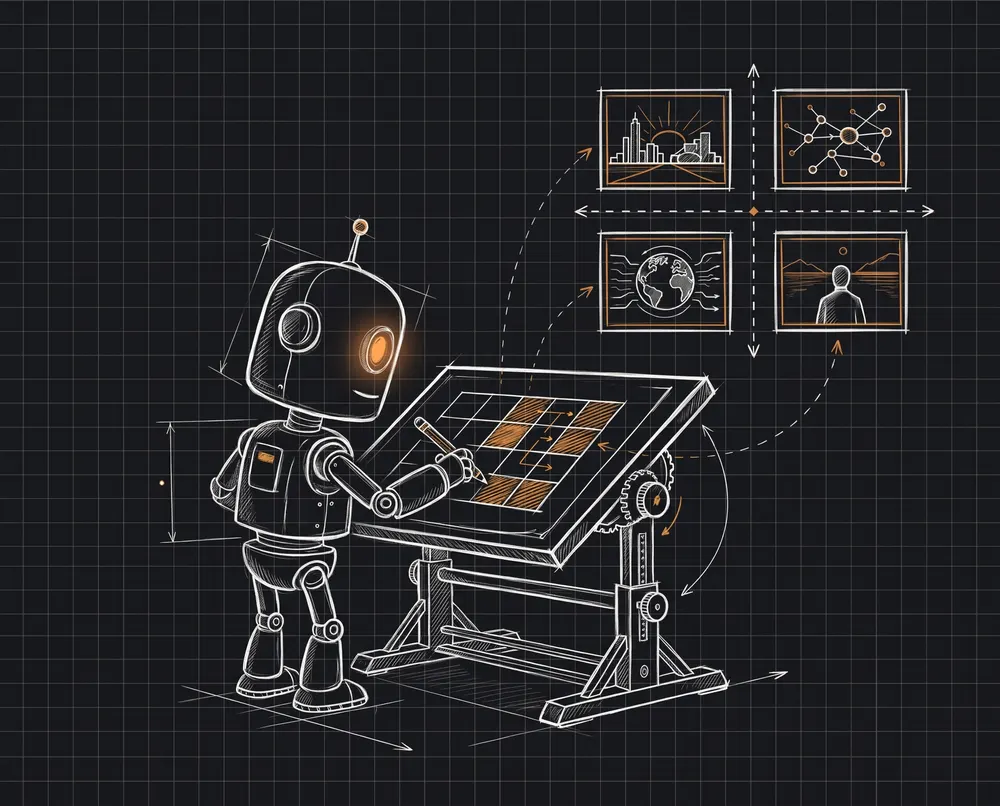
Possible states are described for each key factor and combined into consistent sets, for example as a scenario cross with two axes and four quadrants.
- Write out the scenarios
For each quadrant the agent writes a coherent picture of the future, with its assumptions, its path and the signals that already point towards it today.
- Visualise
The scenarios are turned into images, profiles or comparison boards so they can be laid side by side in workshops and boardrooms.
02 / Division of labour
What the agent does, what humans decide
| Step | The agent | Humans decide |
|---|---|---|
| Impact matrix | rates every pair and explains each rating | correct ratings they see differently |
| Wilson matrix | places drivers by impact and uncertainty | check where the critical drivers sit |
| Key factors | proposes the selection | confirm the key factors |
| Scenario framework | builds states and consistent combinations | confirm the framework |
| Write-up | writes and visualises the scenarios | judge plausibility and relevance to the question |
03 / Limits
What Outlook cannot do
- It cannot produce a future that is not already present in its drivers. What Scout did not find is missing from the scenarios too.
- Language models lean towards the probable. Without deliberate counter-steering, scenarios come out smoother and more alike than they should.
- Consistency is not plausibility. A scenario free of contradictions can still miss reality.
- Scenarios are not forecasts. The agent cannot provide a probability of occurrence beyond an estimate.
Methodological background:
- Vester, Frederic: Die Kunst vernetzt zu denken. Ideen und Werkzeuge für einen neuen Umgang mit Komplexität. Stuttgart: Deutsche Verlags-Anstalt, 1999.
- Gausemeier, Jürgen; Fink, Alexander; Schlake, Oliver: Szenario-Management. Planen und Führen mit Szenarien. München: Hanser, 1995.
- Ralston, Bill; Wilson, Ian: The Scenario-Planning Handbook. Developing Strategies in Uncertain Times. Mason (Ohio): Thomson South-Western, 2006.
04 / In practice
What this looks like in practice
Pictures of Tomorrow focuses a continuous stream of signals on a question through time horizon, industry, region and perspective, and unfolds it into a scenario cross: two axes, four consistent futures, each as an image.
Scenario work with your own agents: Operation Zukunft builds and runs AI agents for innovation and foresight.
Build agents for your foresight work →Published: 16 November 2026 · Last updated: 16 November 2026